
Scale-Up Nightmares: How Batch Mixing Systems Prevent Failures at Full Volume
For manufacturers of blended products faced with the good problem of needing to scale up their operation due to growing demand, the decision of what mixing process to harness couldn’t be more critical to their future success.
At production volumes, mixing processes are often the most critical part of the manufacturing cycle, made up of multiple sequential ingredient dosing, blending, heating, cooling, stabilizing and homogenizing steps. Now comes the most frequent first decision that manufacturers must make: Do you design your production with these steps occurring across separate stand-alone processes, or do you design to have a centralized, integrated batch operation?
We’ve seen instances of manufacturers making the wrong decision and ending up with the nightmare of unmet demand and wasted sunk costs, but we won’t jump ahead of ourselves. First, let’s define each option a bit further.
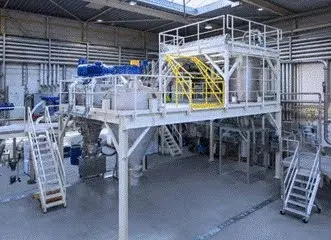
- With stand-alone batching, process steps occur across multiple, disparate vessels and equipment, each operated independently by human staff. Operators must manually control, transfer and monitor each step along the way.
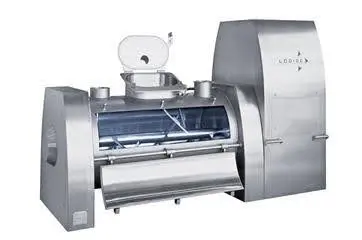
- With integrated batching, process steps occur within a single vessel or group of vessels that are interconnected and controlled by a common automation platform. For example, using a Lodige Ploughshare Batching System, all process steps – ingredient dosing, mixing, tempering and homogenizing – happen in a single vessel, which eliminates excess equipment and handling.
At first blush, the benefits of using an integrated batch system instead of stand-alone batching likely jump right out at you: There’s less handling, less equipment and highly automated control. However, there are cases where stand-alone batching is preferred, so you should fully understand each option before deciding.
Comparing Integrated vs Stand-Alone Batch Mixing Processes
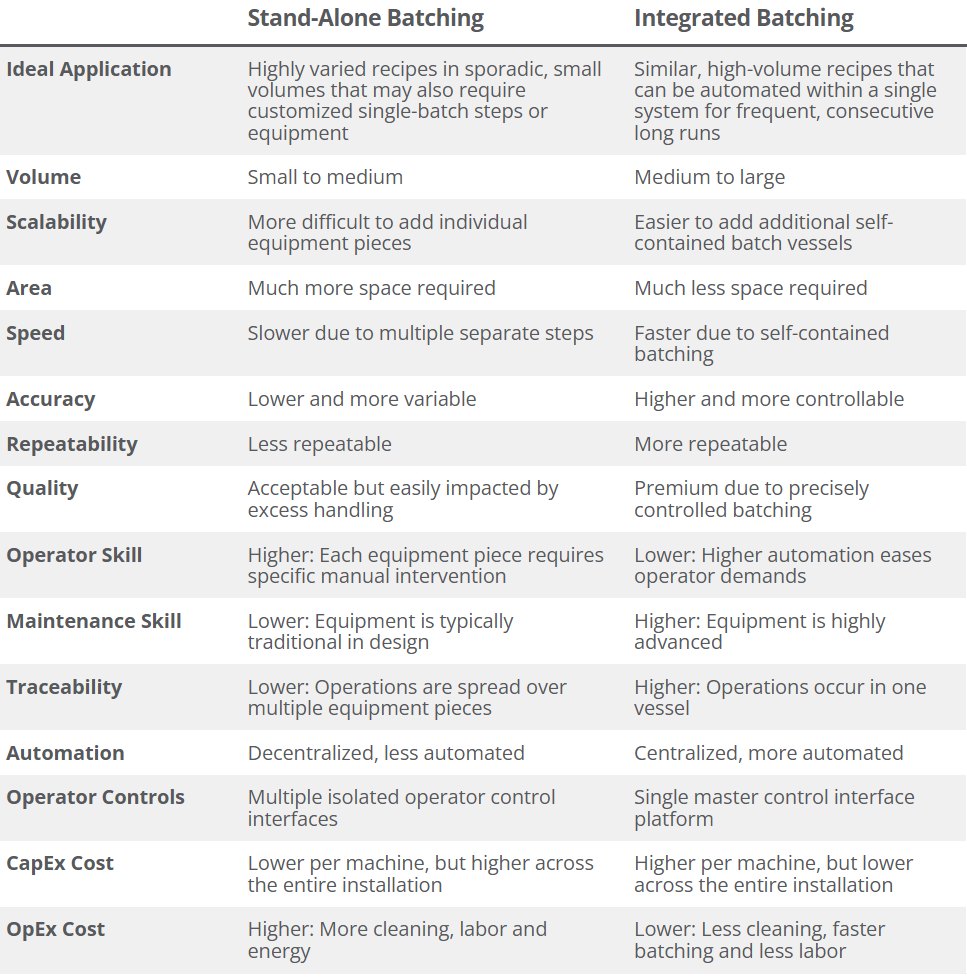
Next, we’ll help you get familiar with the benefits and limitations of stand-alone and integrated batch systems, using this comparison table:
| Stand-Alone Batching | Integrated Batching | |
|---|---|---|
| Ideal Application | Highly varied recipes in sporadic, small volumes that may also require customized single-batch steps or equipment | Similar, high-volume recipes that can be automated within a single system for frequent, consecutive long runs |
| Volume | Small to medium | Medium to large |
| Scalability | More difficult to add individual equipment pieces | Easier to add additional self-contained batch vessels |
| Area | Much more space required | Much less space required |
| Speed | Slower due to multiple separate steps | Faster due to self-contained batching |
| Accuracy | Lower and more variable | Higher and more controllable |
| Repeatability | Less repeatable | More repeatable |
| Quality | Acceptable but easily impacted by excess handling | Premium due to precisely controlled batching |
| Operator Skill | Higher: Each equipment piece requires specific manual intervention | Lower: Higher automation eases operator demands |
| Maintenance Skill | Lower: Equipment is typically traditional in design | Higher: Equipment is highly advanced |
| Traceability | Lower: Operations are spread over multiple equipment pieces | Higher: Operations occur in one vessel |
| Automation | Decentralized, less automated | Centralized, more automated |
| Operator Controls | Multiple isolated operator control interfaces | Single master control interface platform |
| CapEx Cost | Lower per machine, but higher across the entire installation | Higher per machine, but lower across the entire installation |
| OpEx Cost | Higher: More cleaning, labor and energy | Lower: Less cleaning, faster batching and less labor |
Scale Smart: Key Decisions in Selecting an Optimal Batch Mixing System
As we can see in the above comparison table, stand-alone batching is favored for its lower cost and simplicity, whereas integrated batching is favored for its extreme accuracy and performance.
However, there are a few higher-level points that you should consider first to frame your decision:
- Total production volume: Being the higher cost option, an investment into integrated batching technology typically requires a minimum production volume. If your operation doesn’t have the total volumes to keep the batch mixer running, likely stand-alone batching is the better choice until volumes increase.
- Batch volume: Carrying on from the above point, total volume should also be compared against batch volume sizes. Integrated batch systems are custom-built in a wide range of volumes, so there is almost always a break-even point between batch volume and total volume that justifies an integrated batch mixing system.
- SKU mix: SKU count plays into batch system volume sizing as well, in that an extremely wide range of dissimilar SKUs often aligns with the ad-hoc nature of stand-alone batching, whereas a moderate range of similar SKUs can be greatly streamlined through a single integrated batch mix system.
- Mixing method: Stand-alone batch systems typically favor simple mixing methods, using generic drop-in agitators for single-action mixing. Integrated batch systems offer significantly more options such as compound agitators, sidewall scrapers, chopping devices and even pneumatic or ultrasonic mix-assist devices – all of which can tackle the toughest formulations automatically.
- Yields: Stand-alone batch systems frequently suffer from product losses and lower yields due to having multiple equipment pieces where product lingers, compared to integrated systems, where in-vessel retention is substantially reduced. For commodity products, this may not be a concern. For premium products, however, such losses add up very quickly over time.
- Hazardous/sensitive materials: The rule with hazardous and sensitive materials alike is “the less handling, the better.” By their nature, stand-alone systems involve more product handling and larger risk, whereas integrated systems minimize handling and mitigate this risk.
Avoiding the Nightmare of Batching System Failures
Scaling up a mixing operation doesn’t have to give you nightmares of selecting the wrong batch system. Here at Lodige, we’ve been helping customers scale their manufacturing processes for the better part of 100 years, and stand ready to support you on your scale-up journey.