Customizable Mixing Systems: Battery Manufacturing Innovations and Improved Output
Key Takeaways
- Battery ingredient mixing is a critical process step that can make or break an entire battery manufacturing operation.
- Customizable mixing systems for battery manufacturing can be designed for the specific challenges involved in handling aggressive, hazardous, valuable battery slurry ingredients.
- Customizing systems is the best way to solve these challenges while also driving continuous improvements throughout the battery manufacturing process.
Powder mixing is a mission-critical step in modern battery production that presents equal opportunity to amplify or decimate an entire battery manufacturing operation.
When battery ingredients are mixed poorly, the resulting batteries are likely to suffer from poor electrochemical performance and premature failure. On the other hand, when battery ingredients are mixed well, those batteries often exceed their rated lifespans and capacities by a notable margin.
For these reasons, manufacturers should strongly consider how customizable mixing systems battery solutions can help improve their processes and ensure total confidence in their products.
Mixing the Key Ingredient: Battery Masses
A typical battery manufacturing process begins with the preparation of active ingredients into a conductive slurry that is later applied to the battery’s electrodes. Such slurries are referred to interchangeably as “battery slurries” or “battery masses.”
For new battery production, battery slurries contain very precise proportions of ingredients such as lithium, graphite, nickel, manganese, binders and solvents designed to achieve specific electrochemical properties.
Interestingly, mixing processes are also used in recycling applications, where discarded batteries are shredded into battery masses that are then mixed and separated to recover base ingredients.
In both cases, battery masses present multiple process challenges that mixing equipment must be designed to solve:
- Aggressive wear
- Cross contamination
- Oxidation
- Active ingredient sensitivity
- Difficult ingredient homogenization
- Hazardous process safety
Customizing a Mixing System for Battery Production
Seeing the challenges above, you can appreciate the engineering complexity involved in designing a world-class battery ingredient mixing system. Though complex, battery mixing applications are not insurmountable: Quite the opposite. Drawing from Lodige’s own customizable mixing systems battery lineup, here are the most important design features of any battery mixer:
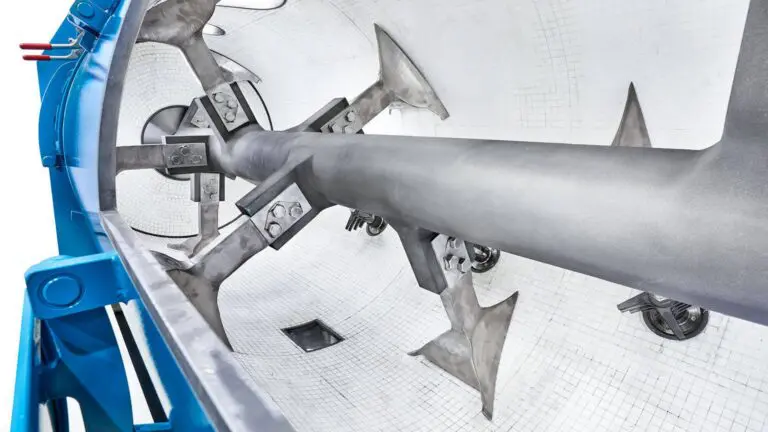
- Resilient internal vessel lining: Mix vessels must be internally lined with hardened ceramic tiles that withstand the extreme abrasion induced by battery slurry ingredients.
- Coated mixing components: Aside from the above vessel lining, all other internal mixer components (e.g. the mixer shaft and shovels) shall receive a resilient wear coating such as polyurethane, tungsten carbide or ceramic oxide.
- Metallic isolation: Linings and coatings are not just for abrasion resistance, but are also necessary barriers between conductive ingredients and metallic surfaces so that stray electrical currents aren’t created during mixing.
- Special seals: All openings into a battery mixer must be positively sealed using compatible elastomers and air-purged mechanical seal assemblies to contain hazardous dusts and restrict outside air ingress.
- Dispersing and agglomeration: Battery mixers benefit from incorporating rotary choppers to expedite dispersing, crushing and agglomerating naturally inconsistent bulk battery mix ingredients.
- ATEX / NFPA rating: Battery mixers shall be designed to meet NFPA / ATEX standards for explosion protection, intrinsically safe electrical circuits, ignition source containment and explosive dust hazard mitigation.
Using Custom Mixers to Achieve Production Excellence
Not only do custom battery mixers set the groundwork for a safe, effective manufacturing process, but they also provide the foundation that innovative and optimized process operations can be directly built upon. Custom mixers open the door to advanced recipe profiles, exotic ingredient additions, ultra-high uptime and yields, and many more options that we’d be happy to discuss with you here.