
Key Takeaways
- Rotary vacuum dryers are advanced industrial manufacturing process equipment systems used to produce ultra-premium powder products.
- The key benefit of these systems is that they create a low-vacuum mixing environment during operation. This allows moisture to be extracted from powder products at a lower temperature, which protects active and sensitive ingredients.
- Powders that don’t dry well enough get “sticky,” leading to clumping, bridging, inconsistent flow and poor cleaning. Rotary vacuum dryers remove moisture reliably so these issues don’t happen at all.
Rotary Vacuum Dryers for Ultra-Premium Powder Products
To manufacturers of industrial powders, “quality” represents three things: function, form and flow. For a powder product to rise to the level of ultra-premium quality, that powder must possess exceptional functional attributes, be highly uniform and freely flow without any discernable clumping or caking.
Products with these features aren’t inherently easy to produce, especially for complex applications such as foods, plastics, minerals and pharmaceuticals. In many such cases, the difference between ultra-premium and average quality comes down to the process equipment being used – most importantly, the powder mixer. And while there are many types of mixers available on the market, one mixer design is especially recognized for meeting extreme expectations of function, form and flow: the rotary vacuum mixer/dryer (often referred to as just a rotary vacuum dryer).
The Core Design Principles of a Rotary Vacuum Dryer
Using our Lodige Druvatherm Rotary Vacuum Shovel Dryer as an example, rotary vacuum dryers combine mixing, granulation, drying and cooling all into a single process vessel that can simultaneously mix ingredients and reduce moisture in one step.
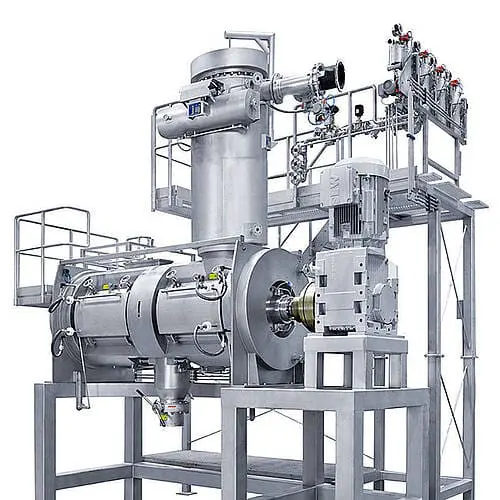
Here’s how a rotary vacuum dryer works, explained through its primary design principles:
- Horizontal mixing vessel: Products are loaded in the dryer’s horizontal mix tank, where all process steps are carried out. The horizontal tank design allows for shallow product mass depths, larger mix surface areas and three dimensions of mixing action.
- Active, gentle agitation: The dryer’s horizontal agitator uses shovel-type heads to mechanically induce a fluidized bed effect within the product, prompting extremely fast mixing to full homogeneity. Shovel heads rotate at slow speeds and generate low shear forces, protecting sensitive materials.
- Thermal jacketing: This process completely encapsulates the mixing vessel, through which hot or cold utility media can flow (typically hot water or low-pressure steam). Using this jacketing, the product can be thermally controlled to precise temperatures under which chemical reactions, ingredient binding, solvent and vapor release, and in the case of dryers specifically, moisture evaporation can optimally occur.
- Applied vacuum: During operation, a variable vacuum is pulled on the mix chamber to promote the desired reactions and evaporation to occur. When pressure is reduced in the mix vessel, evaporation and media release can occur at lower overall temperatures, which is another way that sensitive products are protected by not being exposed to excessive thermal conditions.
- Multi-phase processing: Rotary vacuum dryers offer the inherent benefit of being able to perform mixing, granulation, drying, cooling and deagglomeration all within the same system (when so configured). Beyond the CapEx and OpEx savings of using fewer pieces of equipment, product quality also gets a boost via greatly reduced handling and batch times.
- Solvent and condensate recovery: Most rotary vacuum dryers come equipped with standard solvent recovery kits, which collect and condense valuable airborne elements pulled out of the mix by the system’s vacuum draw that would otherwise be lost to atmosphere. In some cases, solvent recovery is added for safety and code compliance, containing hazardous fumes and vapors.
Avoiding Sticky Products
At the start of this article, we mentioned three attributes used to define ultra-premium powder products: function, form and flow. Now that you know how rotary vacuum dryers operate, we’d like to expand on how such dryer systems directly improve these attributes. To do so, we need to introduce the concept of “sticky” powders.
When a powder product is referred to as sticky, it exhibits some combination of particulate cohesion, clumping, caking, relatively high moisture and surface adhesion. Sticky powders are rarely desirable, as they do not process easily nor function properly for end-users. All else equal, powders must be completely free of sticky-like properties to fulfill the these highest attributes:
Function
Functional properties of powders can be described as the powder’s ability to achieve a particular chemical, mechanical or nutritional state. Whether a powder needs to hydrate instantly, disperse consistently, maintain bioactivity, retain nutrients or react uniformly, powders with sticky properties are less likely to achieve these functional goals. A rotary vacuum dryer directly improves powder functionality by maintaining the integrity of active ingredients and cellular structures, thanks to low-temperature, gentle moisture removal.
Form
A powder’s form is all about its physical condition, namely that its particle sizes are uniform, properly shaped and on-spec in terms of density, solubility and compressibility. Powders with excess moisture are often difficult to process into the correct form, presenting clumps and oversized particles with rough textures instead. Rotary vacuum dryers improve a powder’s form by achieving very consistent particle sizes and shapes, on account of the dryer’s mechanically induced fluidized bed mixing action and customizable shovel designs.
Flow
From the perspective of process operators and end-users of industrial powders, flow describes how easy or difficult a powder will be to handle. Sticky powders do not flow easily, causing all sorts of issues as they’re filled, discharged, processed and even stored. Low-grade, sticky powders take more horsepower to convey, skew mass flow and density measurements, condense and even congeal in bulk storage, adhere to equipment and tubing sidewalls, and take more manual intervention overall. Rotary vacuum dryers practically eliminate all these issues by reducing moisture and breaking apart agglomerates to spec every time.
Good Flow Is Great; Bad Flow Is Terminal
Clearly, rotary vacuum dryers can solve a host of technical powder processing challenges and produce some of the highest quality powder products possible. Out of all these benefits, we often come back to flow. For most customers of powder products, flow is the attribute they experience first, and seeing a free-flowing, non-bridging, easily handled powder inspires extreme confidence before they even evaluate form and function in their downstream processes.
From a customer’s perspective, good powder flow is impressive, but bad flow is reason enough to switch brands outright. If you’d like to learn more about improving your powder products’ flow and overall quality using a rotary vacuum dryer, our team is here to help.