Key Takeaways
- Large industrial mixer systems are great for high-volume production, but this feature may also inadvertently limit a business’s ability to pursue new opportunities.
- Manufacturers must protect their capacity to experiment, develop new and improved offerings, and overall tune their business to changing market needs.
- To help you achieve both high-volume production and innovative flexibility at once, evaluate your process for these telltale symptoms and potential solutions.
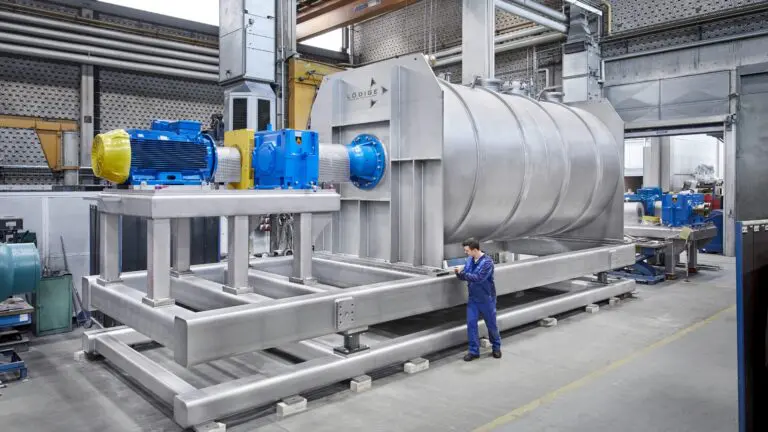
In our experience with process mixing systems, a manufacturer can build a large industrial mixer operation that is so fully dedicated to high-volume production that the company becomes restricted from pursuing emerging opportunities. Manufacturers need to protect their ability to experiment and innovate, so avoiding this problem with large industrial mixer systems is paramount.
How can large mix systems present barriers to growth? How can manufacturers have the best of both scale and innovative flexibility? We answer both questions below.
Large Mixer Attributes That Hamper Organizational Innovation
Large industrial mixer systems are often designed primarily to batch high volumes of similar recipes for long production runs. These design features are great for scale, but are detrimental to new product development in the following ways:
- Mixer is too large for pilot testing. Large-scale mixers have a sizable minimum effective batch volume, often well over the size needed for small test batches. As such, large mixers can’t provide reliable proof-of-concept pilot results.
- Batch size is too large to optimize. In addition to being unable to run small initial test batches, oversized mixers are also often too large to run iterative tuning batches meant for optimizing a recipe.
- No available batch time for R&D. Most high-volume mixers are perpetually scheduled for production runs, offering no available time to run research and development batches.
- The mix system is not suitable for customization. Sizable process mixers are usually designed for high-volume production, making them poor candidates for modifications or customization to support pilot-scale recipes.
- Design is incompatible. Large mixer features may be simply incompatible with new recipes in terms of ingredient handling, mix method, dosing accuracy, thermal control, materials, finishes and more.
- Turnaround time is long. Large process mixers have set maintenance, cleaning and change-over procedures that take a relatively long time, which is better spent preparing for primary production instead of incidental pilot tests.
- Waste can be high. Large industrial mixers can cause excessive amounts of waste when attempting small pilot runs, notably in terms of lost product and utility consumption (like power, air and water).
Balancing Raw Market Share and Strategic Dexterity
High-volume process mixing is a function of mass production, which serves the goal of a company chasing high market share. Conversely, innovation is all about nimbly testing small new market opportunities until one sticks well enough to warrant scaling up. Manufacturers can certainly do both by adopting one of two intentional strategies:
Add a Pilot Mix System
Practically all styles of process mixers are available in pilot or lab scales, either of which can be used for batch testing while existing large mixers stay dedicated to primary production. For example, see Lodige’s lab-scale Ploughshare mixer and mixing granulator.
The beauty of pilot systems is, when specified correctly, they will accurately produce identical results to their production-scale counterparts, making pilot analysis a reliable process.
Utilize a Third-Party Test System
If investing in a pilot system is out of the question, manufacturers can instead work with experienced third-party companies to perform offsite pilot tests.
On the upside, third-party resources often offer multiple different pilot systems that a manufacturer can experiment with. In addition, these resources usually offer value-added expertise and consulting to support the manufacturer’s innovation efforts. See Lodige’s Test Center offerings for an example.
On the downside, third-party resources will have a cost associated with their services and require ample coordination ahead of testing. But, these costs are quite easily recouped as a viable product scales up.
Can’t Decide? We Can Help
Innovative flexibility and mass-scale production are definitely not mutually exclusive. By using pilot test systems – whether directly owned or accessed through a third party – manufacturers can ensure that their R&D efforts continually fuel positive business growth. Have more questions? Reach us here at your convenience.