Key Takeaways
- Industrial powder manufacturing is inherently a “dirty” process, yet must be kept clean enough to control safety hazards and product quality.
- This makes powder equipment CIP (clean in place) practices difficult, as wet cleaning is more effective but also adds the risk of water-borne issues in an otherwise dry environment.
- To balance sanitation effectiveness and risk, there are critical factors to incorporate into both the design and operation of industrial powder mixer equipment.
Despite being commonly known as a “dirty” process, industrial powder mixer systems must balance two opposing forces regarding cleaning: Mix areas must be kept clean enough to control safety hazards (such as explosive dusts), all while managing or completely avoiding the risks of wet cleaning (such as contamination and pathogen growth).
To help you address these issues, we’ll share a handful of suggestions involving powder mixing equipment’s design and operation below.
Identifying Mixer Design Elements That Drive Optimal Cleaning
Powder mixing cleaning regimens will vary by industry and application, but in all cases, will benefit when mixers are designed with these considerations in mind:
- Product contact material selection: A mixer’s product-contact materials must be selected for compatibility with the products being mixed and the desired cleaning methods, so that they don’t degrade and impede cleaning over time.
- Surface finish: Product-contact surfaces of an industrial powder mixer must be specified to a level of smoothness that deters product buildup and adhesion. When internal surfaces are too rough, product can pack into their uneven texture.
- Weld and joint finish: All welds and joints need additional attention to eliminate uncleanable textures and shapes. Welds are often ground down to smooth out weld bead profiles, and joints must be designed free of harborage points.
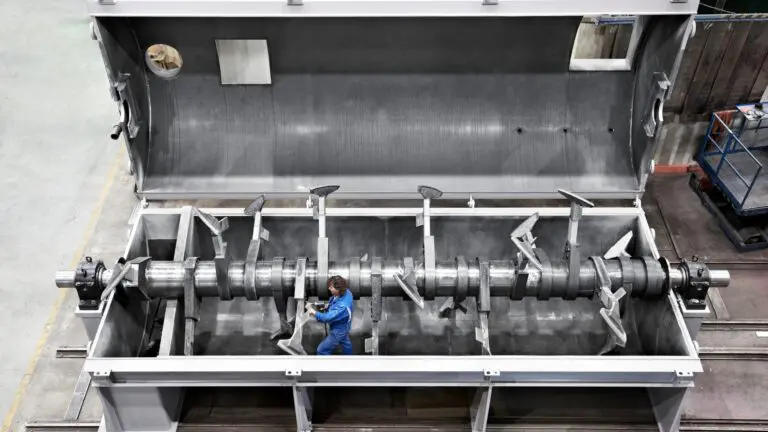
- Internal feature design: Many mixer styles incorporate internal features such as choppers, scrappers, spray bars and nozzles, all of which must be designed to avoid cleaning shadows (areas blocked from cleaning coverage).
- Spray device selection: Powder mixers often use spray devices to shower the vessel’s internal surfaces, which must be selected for the correct flowrate, pressure, velocity and impingement force, and laid out for full coverage.
- Free draining: Powder mixers must be designed to be free draining, such that every surface of the mixer is shaped and positioned so that powder and CIP solution fully drain without any pooling or retention.
Operational Considerations for Powder Mixer Sanitation
When it comes to effective industrial powder mixer sanitation, how a mixer is operated is just as important as how the mixer is designed. In fact, even the best designed mixer will be negatively influenced by poor operational practices.
Consider these plant-side operational factors, for example:
- Time/temperature profile: Thermal powder mixers are subject to fouling (undesired product buildup) due to excessive temperature setpoints or rate of change. A recipe’s time/temperature profile must be optimized to combat fouling, just as a CIP time/temp profile should be optimized for cleaning.
- CIP circuit hydraulics: When powder mixers are cleaned using external CIP systems, the mixer is entirely reliant on the CIP system’s hydraulic and thermal performance. For this reason, CIP programs should be validated and maintained against specific flow, pressure, velocity and temperature criteria.
- Chemical selection: Cleaning chemicals must be intentionally selected for the types of soils that they’re treating and should only be used at prescribed concentrations. Incorrect chemicals at incorrect dilutions adversely impact cleaning.
- Powder properties: Most powder recipes are optimized for final product specifications but leave upstream physical properties less tightly defined. In such cases, many products benefit from early improvements to their properties (EG moisture, particle size) to improve system-wide handling and cleaning load.
Putting Cleaning Woes Behind You
Process mixer sanitation is much easier to solve with new mix systems than with existing systems, but that doesn’t mean that existing systems aren’t equally worth the effort. In both cases, the benefits of optimizing mixer cleaning to labor, energy and chemical consumption, uptime, and quality factors are unignorable. Care to learn more? Contact us here.